
Case Study: Brain Odyssey Interactive Immersive Exhibit
The Brain Odyssey is an immersive 3D neuroscience exhibit by Intervoke that lets museum and hospital visitors explore the human brain down to the synapse.

The Brain Odyssey is an interactive, immersive neuroscience exhibit that takes visitors on a journey from the outer lobes of the human brain down to neurons, synapses and neurotransmitters. Intervoke created the scientifically accurate 3D content and developed the interactive software that drives all of it. The touchscreen user interface was developed by interactive exhibit designer Ideum.
The exhibit launched in March 2019 as "Deep Dive into the Brain," a centerpiece of the Journey Through the Human Brain exhibition at the South Florida Science Center and Aquarium (now the Cox Science Center and Aquarium) in West Palm Beach, Florida. Renamed the Brain Odyssey, it is now installed at science museums and hospitals in the United States and Europe.
The challenge
The Cox Science Center (then the South Florida Science Center and Aquarium) was building Journey Through the Human Brain, a $2.5 million, 2,500-square-foot permanent gallery developed with Florida Atlantic University's Brain Institute. The center wanted a centerpiece that would appeal to adults as well as children and show the brain in a way no textbook or model could.
That meant solving several problems at once:
- Scale. The brain's most important activity happens at the microscopic level, far too small to see. Visitors needed to travel smoothly from whole-brain anatomy down to single synapses without getting lost.
- Accuracy. A science center's neuroscience exhibit must be correct, but still clear to a 10-year-old.
- Immersion. According to Ideum's project summary, the content had to stay sharp on a 14-foot curved projection wall as visitors panned, selected areas and dove in.
- Accessibility. The controls had to work for every visitor, including wheelchair users.
Who it's for
The Brain Odyssey is built for any organization that wants to make neuroscience tangible.
Our process
Intervoke and Ideum took the Brain Odyssey from scientific concept to a permanent immersive exhibit, then turned it into an exhibit any venue can install.
1. Scientific content and 3D modeling
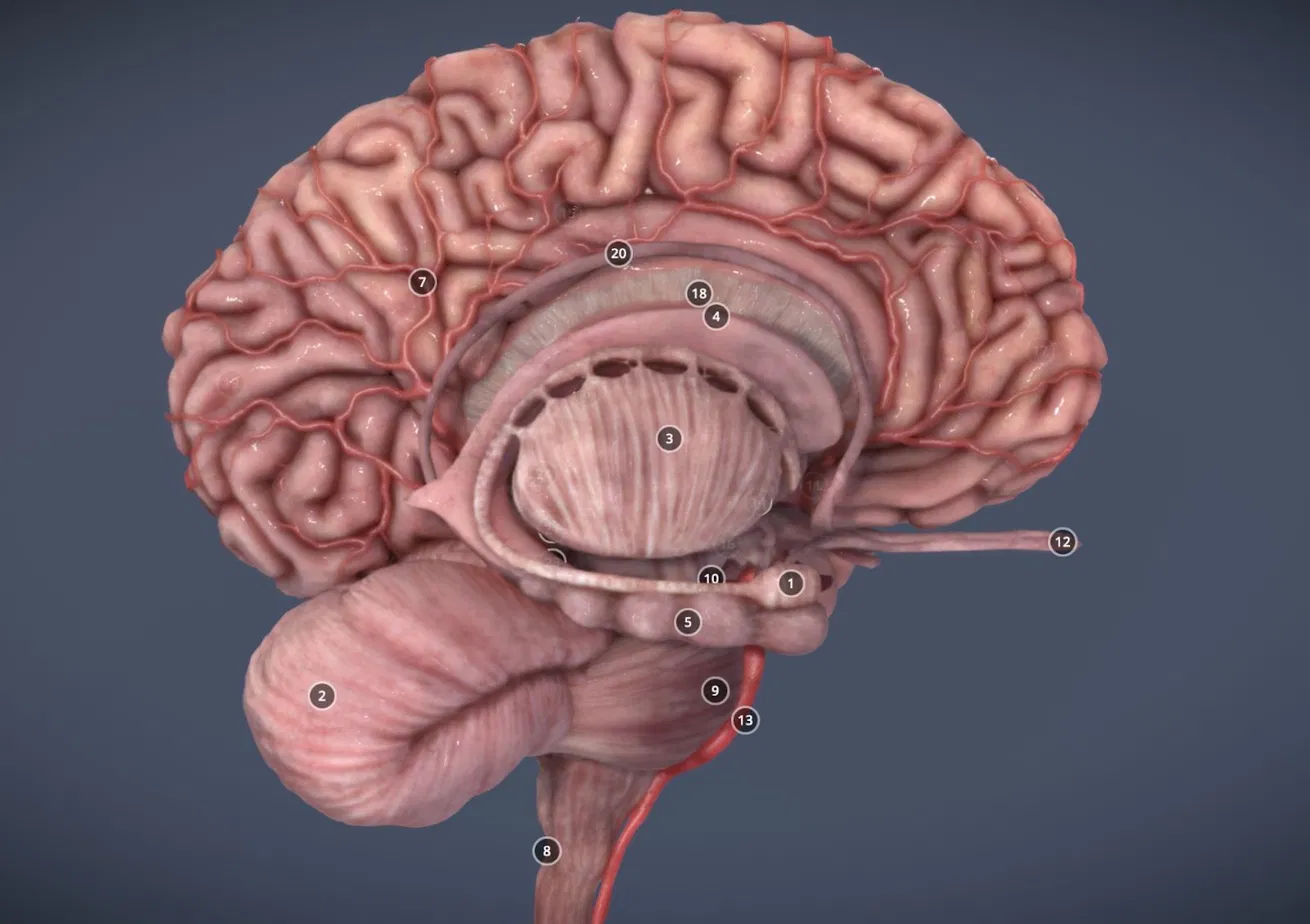
Intervoke built a scientifically accurate 3D model of the human brain at every scale, from the outer lobes and fissures to deep internal structures, neurons and synapses. Intervoke created the 3D brain structures and the complete dive sequence in Unity3D, along with the projected imagery. Each level was planned as a step in one continuous journey, so visitors always know where they are.
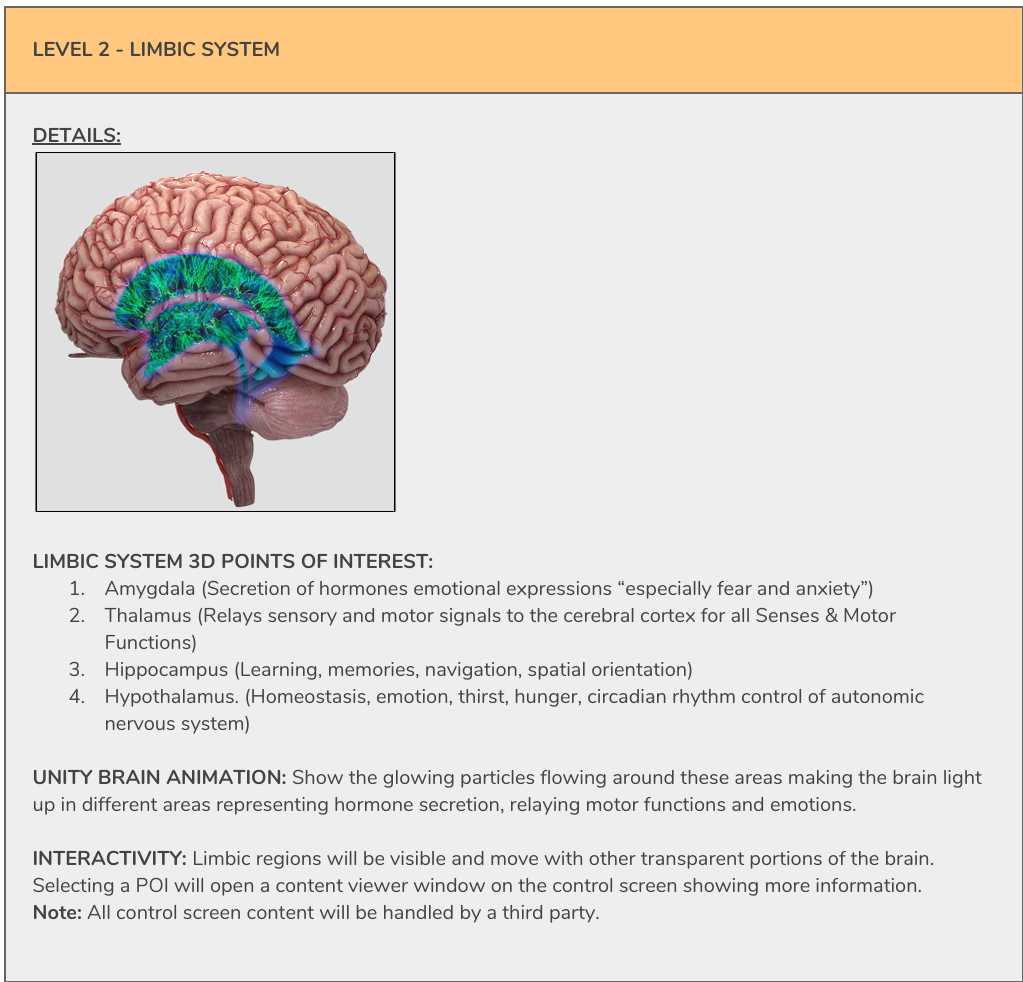
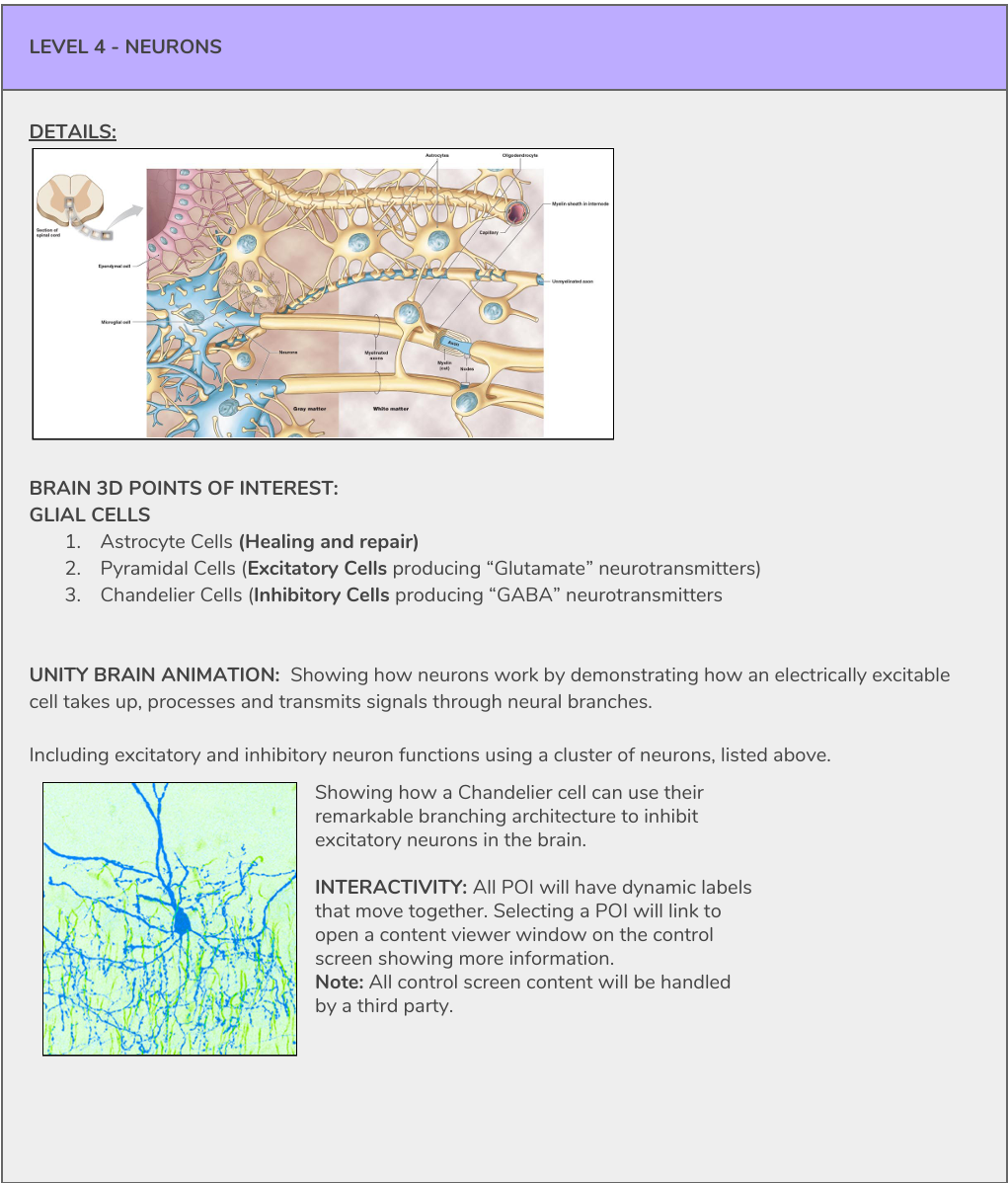
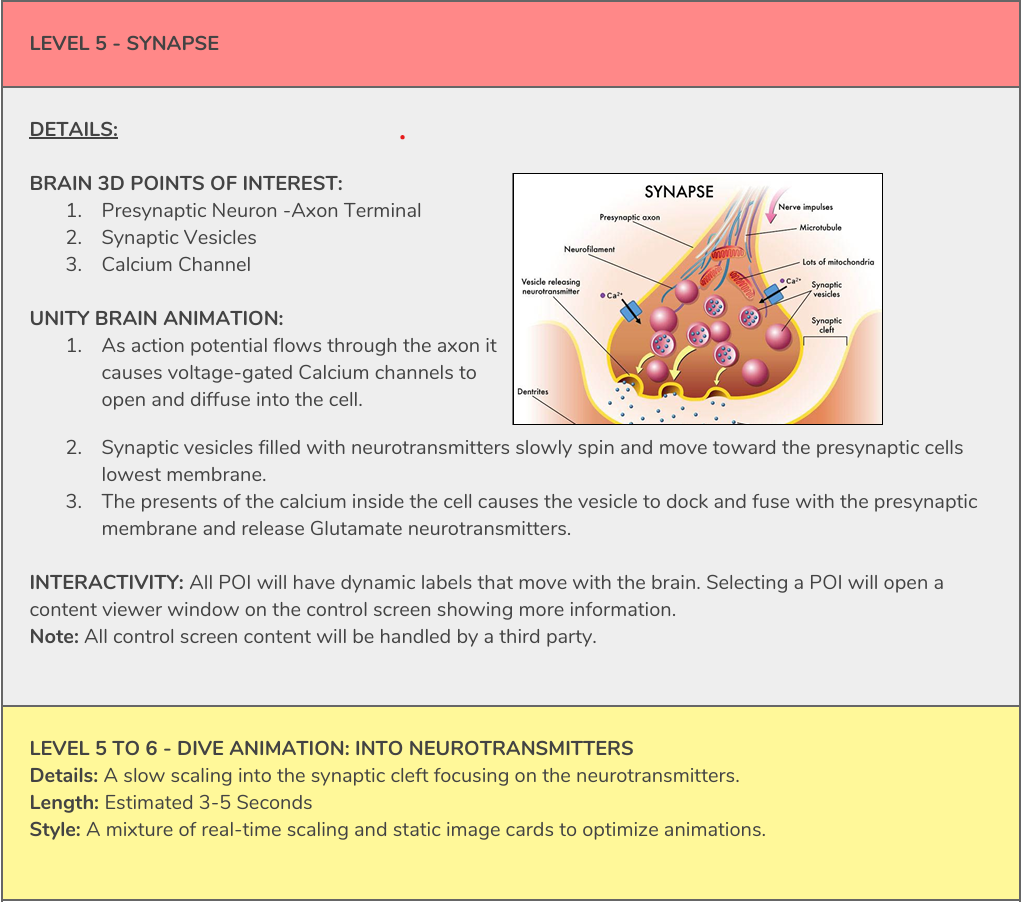
The Intervoke team brought together a medical content developer, who wrote the content and storyboards, a subject matter expert, who reviewed it for medical accuracy, medical illustrators, and Unity engineers and 3D artists. The storyboard defined six levels, each with its own 3D points of interest:
- Home screen: the brain. The cerebral blood vessels and the frontal, parietal, temporal and occipital lobes.
- Limbic system. The amygdala, thalamus, hippocampus and hypothalamus.
- Hippocampal circuits. The electrical pathways that support memory and navigation.
- Neurons. Excitatory and inhibitory neurons, and the glial cells that support them.
- Synapse. The axon terminal, synaptic vesicles and calcium channels.
- Neurotransmitters. Glutamate crossing the synaptic cleft and binding to AMPA and NMDA receptors.
Six "dive" transitions link the levels, so the journey feels like one continuous zoom. A final transition carries visitors from the microscopic level back out to the whole brain to start again.
2. Real-time 3D and interactive design
Intervoke developed the interactive software behind all of the 3D content. It runs in real time in Unity3D, so visitors steer the journey instead of watching a fixed video. Ideum developed the user interface for the touchscreen panels, which connects to Intervoke's 3D software so visitors can select structures and learn more.
For each level, the storyboard spells out the points of interest, the animation and the interaction. Intervoke modeled, sculpted, textured, rigged and light-baked the 3D anatomy in Maya, then built the materials, lighting and C# software in Unity3D. Every point of interest has a label that moves with the brain, and selecting one opens more information on the touchscreen.
The build ran in three milestones, each ending with a review by the science center:
- Milestone A (August to September 2018): software design document, written storyboard, and the home screen with its rotating brain, neural-activity animation and lobe highlighting
- Milestone B (September to November 2018): the limbic system, hippocampal circuits and neuron levels, with the first three dive transitions
- Milestone C (November 2018 to January 2019): the synapse and neurotransmitter levels, and the final dive transitions
Intervoke delivered a beta in December 2018 and the final software in January 2019, ahead of the exhibit's March 2019 opening.
3. Prototyping and user testing
The team tested several projection-mapping techniques to fit the 3D imagery onto the 14-foot curved wall. A full-scale mockup was tested for more than a month with the project team and first-time visitors to refine the interface. Lighting was tested, and the console was designed for wheelchair users, with readable text and well-sized controls.
4. Installation and refinement
Ideum built the custom console, with a 43-inch touchscreen and a joystick, and installed the exhibit. A Barco 4K UHD projector fills the 14-foot curved wall, large and detailed enough for groups to watch together while one visitor pilots. Ambient audio and lighting complete the immersive atmosphere. After opening, Intervoke and Ideum continued to refine the experience to improve reliability and performance.
5. Ready for new venues
In 2020, Intervoke and Ideum released the Brain Odyssey as an exhibit available to museums and institutions anywhere. It can be translated, such as the Polish and Ukrainian versions made for the Copernicus Science Centre, and adapted to different gallery sizes and layouts.
Inside the exhibit
The Brain Odyssey is a self-guided journey with no fixed path. Visitors decide where to go and how deep to dive.
- Start at the surface. The first level shows the outside of the brain, with its lobes and fissures. Visitors choose from five areas of interest to explore.
- Dive inward. Each level moves deeper into the brain's internal structures, with animated 3D imagery that highlights key structures and processes.
- Reach the microscopic level. The final level shows synapses, where neurotransmitters carry chemical signals between neurons. This is the part of the brain no visitor could otherwise see.
- Learn on demand. At each stop, visitors use the joystick to select structures, and short explanations appear on the console's touchscreen, so curious visitors can go further while others keep exploring.
- Feel immersed. Large-format projection, ambient audio and lighting make visitors feel like they are traveling inside the brain. At the Pacific Science Center, visitors steer the journey on a touchscreen while it plays across a wall-size screen.
Three ways to install
The exhibit fits galleries of different sizes and budgets:
- Single-user kiosk: a multitouch kiosk, with an optional second display such as a monitor, video wall or projector
- Fully immersive: a projector paired with a 43-inch multitouch table
- Custom touch table: a custom-built table with a frameless touchscreen
The result
The Brain Odyssey grew from a single gallery centerpiece into an exhibit installed at museums and hospitals in the United States and Europe.
- A gallery icon. At the Cox Science Center, the exhibit became an iconic part of the brain gallery and is very popular with visitors, according to Ideum.
- Praised by clinicians. At the Frost Museum of Science, the exhibit was installed with Baptist Health. Neurosurgeon Dr. Michael McDermott, chief medical executive of Baptist Health Miami Neuroscience Institute, called its view of the microscopic level one of its unique features and said it helps people of all ages appreciate the brain's complexity. The Miami Neuroscience Institute now has its own installation.
- Busy from day one abroad. During a public test run at the Copernicus Science Centre in Warsaw, Ideum reported the exhibit was busy and well received.
Frequently asked questions
What is the Brain Odyssey exhibit?
The Brain Odyssey is an interactive, immersive neuroscience exhibit. Visitors steer a real-time 3D journey through the human brain, from the outer lobes and fissures to internal structures, neurons, synapses and neurotransmitters.
Who developed the Brain Odyssey?
Intervoke, a medical animation and interactive 3D studio, created the 3D content and developed the interactive Unity3D software that drives it. Ideum developed the touchscreen user interface, built the hardware and installed the exhibit.
Where can I see the Brain Odyssey?
The Brain Odyssey is installed at:
- Cox Science Center and Aquarium, West Palm Beach, Florida
- Phillip and Patricia Frost Museum of Science, Miami, Florida
- Pacific Science Center, Seattle, Washington
- Copernicus Science Centre, Warsaw, Poland (the English version of their site)
- Baptist Health Miami Neuroscience Institute, Miami, Florida
What age group is the Brain Odyssey for?
The exhibit is designed for visitors from upper elementary school age through adults. It is self-guided, so younger visitors can explore freely while older visitors dive deeper into the science.
What do visitors learn from the Brain Odyssey?
Visitors learn how the brain is organized at every scale. They explore its lobes and fissures, its internal structures, and the microscopic level where neurotransmitters carry chemical signals between neurons.
Can a museum, hospital or university install the Brain Odyssey?
Yes. The Brain Odyssey is available as a permanent installation or featured attraction in three formats: a single-user touchscreen kiosk, a fully immersive setup with a projector and a 43-inch touch table, or a custom touch table. It can be translated into other languages and adapted to different gallery sizes.
Bring the Brain Odyssey to your organization
Intervoke creates 3D medical animation, interactive 3D healthcare applications and immersive exhibits for museums, science centers, hospitals and life sciences companies. To bring the Brain Odyssey to your venue, or to create a custom immersive exhibit, book a discovery call.
Sources
- The Brain Odyssey, Intervoke
- The Brain Odyssey, Ideum
- Brain Odyssey Interactive Exhibit Now Available for Purchase, Ideum, October 12, 2020
- Copernicus Science Centre's New Exhibition Nears Completion, Ideum, June 16, 2023
- Educational Environments: South Florida Science Center and Aquarium, Digital Signage Federation
- Journey Through the Human Brain grand opening, Cox Science Center
- Brain Odyssey at the Frost Museum of Science, Baptist Health (Spanish)
- Play mind games at PacSci's new Brainy Bodies exhibit, Seattle's Child
- Journey Into the Brain, Ideum portfolio
- New Brain Exhibits Installed at South Florida Science Center, Ideum, January 15, 2019
Let’s Get Started
Interested in learning more about how Intervoke can bring your science to life?
Contact us or book a Discovery Call to get started.


