
Case Study: Interactive 3D Healthcare Application for Teva Pharmaceuticals
How Intervoke built an interactive 3D healthcare application for Teva to train HCPs and educate patients on Parkinson’s and hyperkinetic movement disorders.
Overview
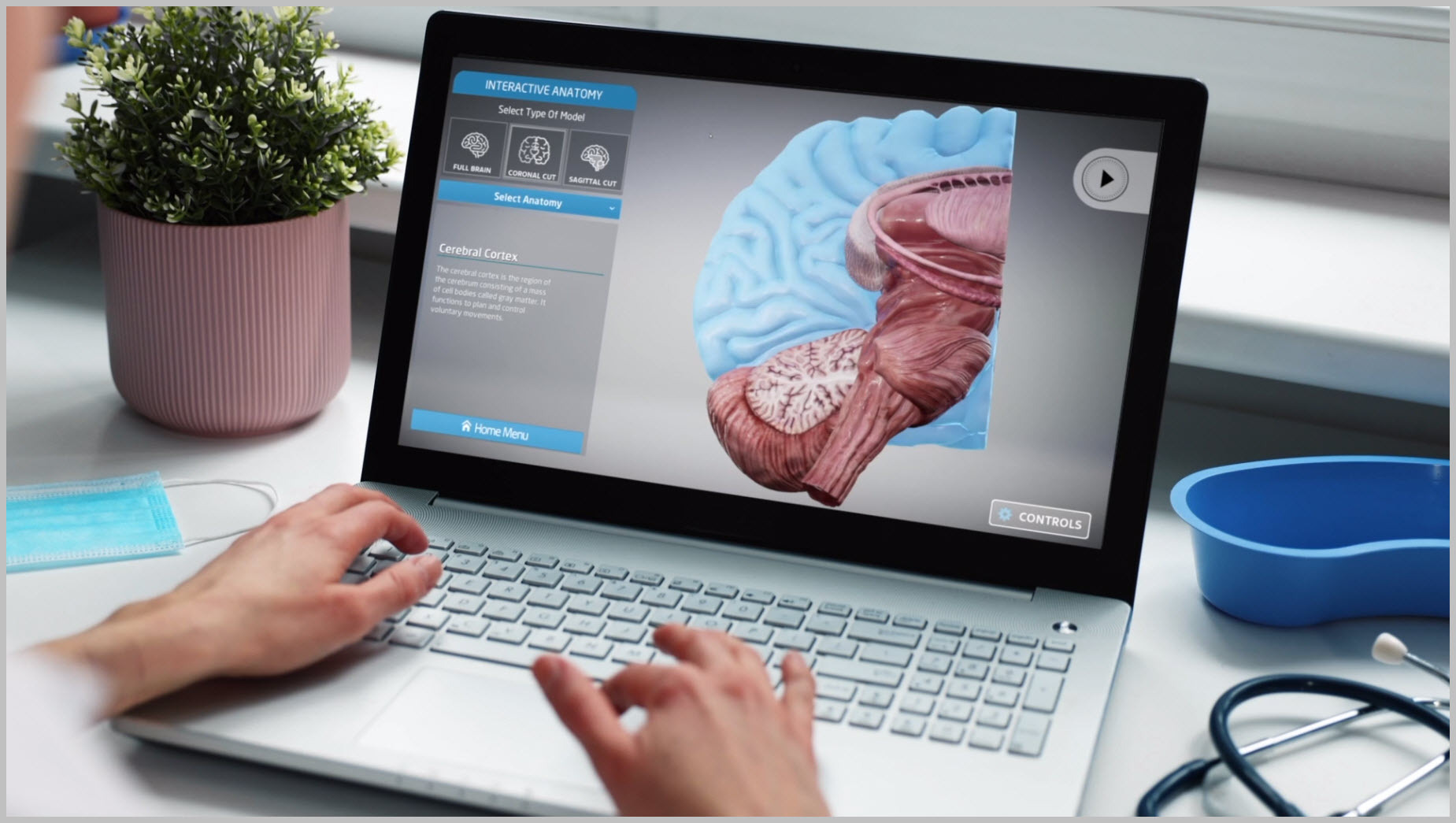
Intervoke built Anatomy of Movement, an interactive 3D healthcare application that teaches how the brain controls movement and what goes wrong in Parkinson's disease and hyperkinetic movement disorders. Teva Pharmaceuticals commissioned it as educational material supporting AUSTEDO (deutetrabenazine), its treatment for chorea associated with Huntington's disease and tardive dyskinesia.
The application combines narrated 3D medical animation with interactive 3D models that healthcare professionals (HCPs) can explore at their own pace. Every key structure and molecule is labeled on screen, with drop-down definitions for deeper learning. The same content works for HCP training and for patient education.
The challenge
Movement disorders start in the basal ganglia, a set of deep brain structures that balance "go" and "stop" signals. In Parkinson's disease, loss of dopamine tips that balance toward too little movement. In hyperkinetic disorders such as Huntington's disease chorea and tardive dyskinesia, the balance tips the other way, causing involuntary movements.
To understand how a treatment like AUSTEDO works, HCPs first need to understand normal movement. That means following signals through the motor cortex, dorsal striatum, globus pallidus, subthalamic nucleus and thalamus, then down to dopamine and acetylcholine acting at single synapses. Static slides and textbook diagrams make this hard to follow.
Teva needed an educational tool that would:
- Explain the direct and indirect pathways clearly enough for non-specialists
- Move smoothly between whole-brain anatomy and cellular-level signaling
- Let learners explore at their own pace, not just watch
- Stay scientifically accurate, with every statement backed by a cited reference
Who it's for
The application serves three audiences with one set of 3D content. Each uses it differently.
The narrated animations give every audience the same core story. The interactive mode lets HCPs and Teva teams go deeper, rotating models and opening definitions as needed.
Our process
Intervoke takes every interactive medical education project from scientific research to final render in six stages. Teva's medical and brand teams review the work at each stage.
1. Scientific research and curriculum planning
Intervoke organized the content into modules that build on each other, from brain anatomy to receptor-level signaling. Every scientific statement in the script is footnoted to a peer-reviewed or textbook source, including Principles and Practice of Movement Disorders and published reviews of basal ganglia anatomy and dopamine signaling. This gives medical, legal and regulatory reviewers a clear reference for each claim.
2. Scripting and storyboarding
Each scene of the storyboard sets four things side by side: the voiceover script, the 3D visuals, the on-screen actions timed to specific words, and the pop-up annotations. For example, when the narrator says "direct pathway," the storyboard specifies that the pathway is outlined and labeled at that moment. This level of detail lets clinicians check the science before any final 3D production begins.
3. Visual language
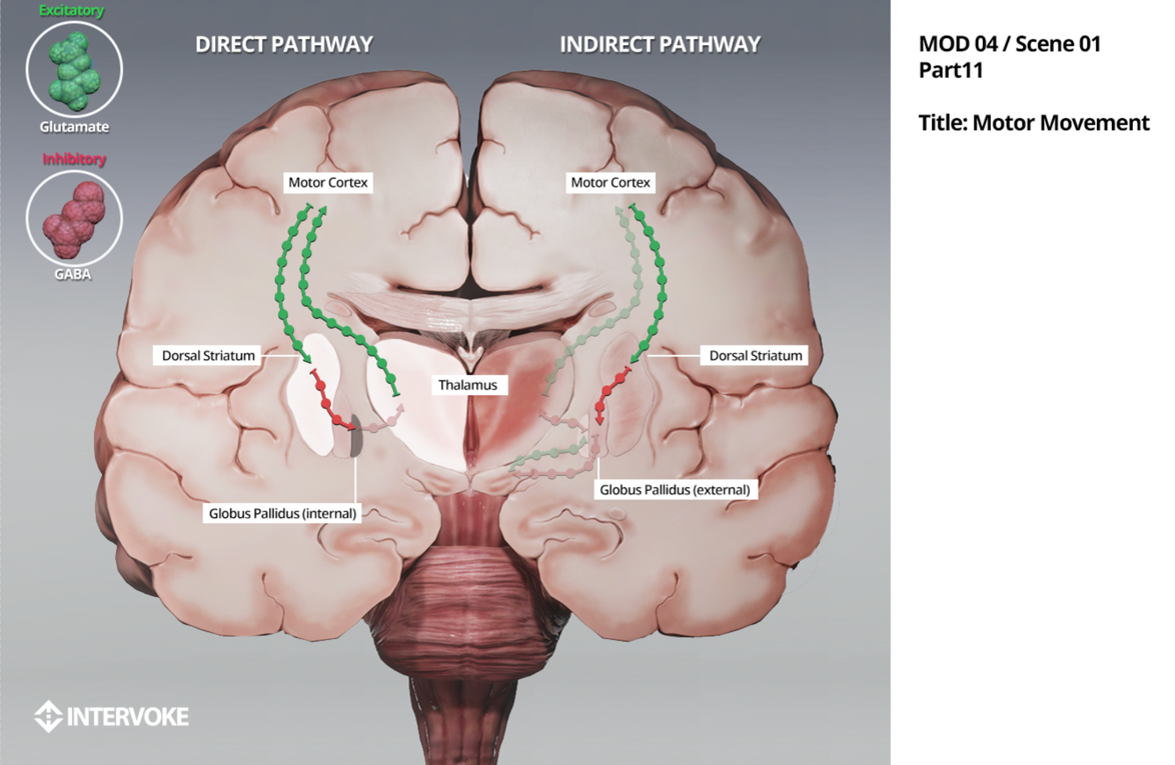
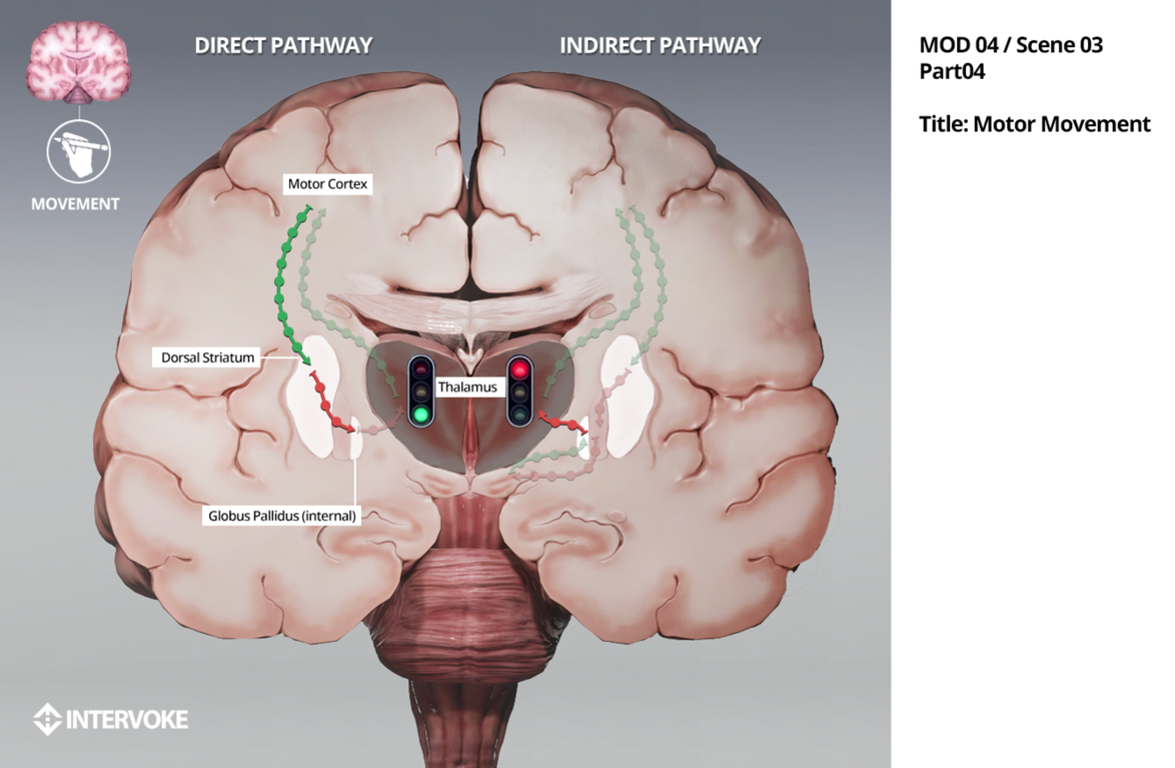
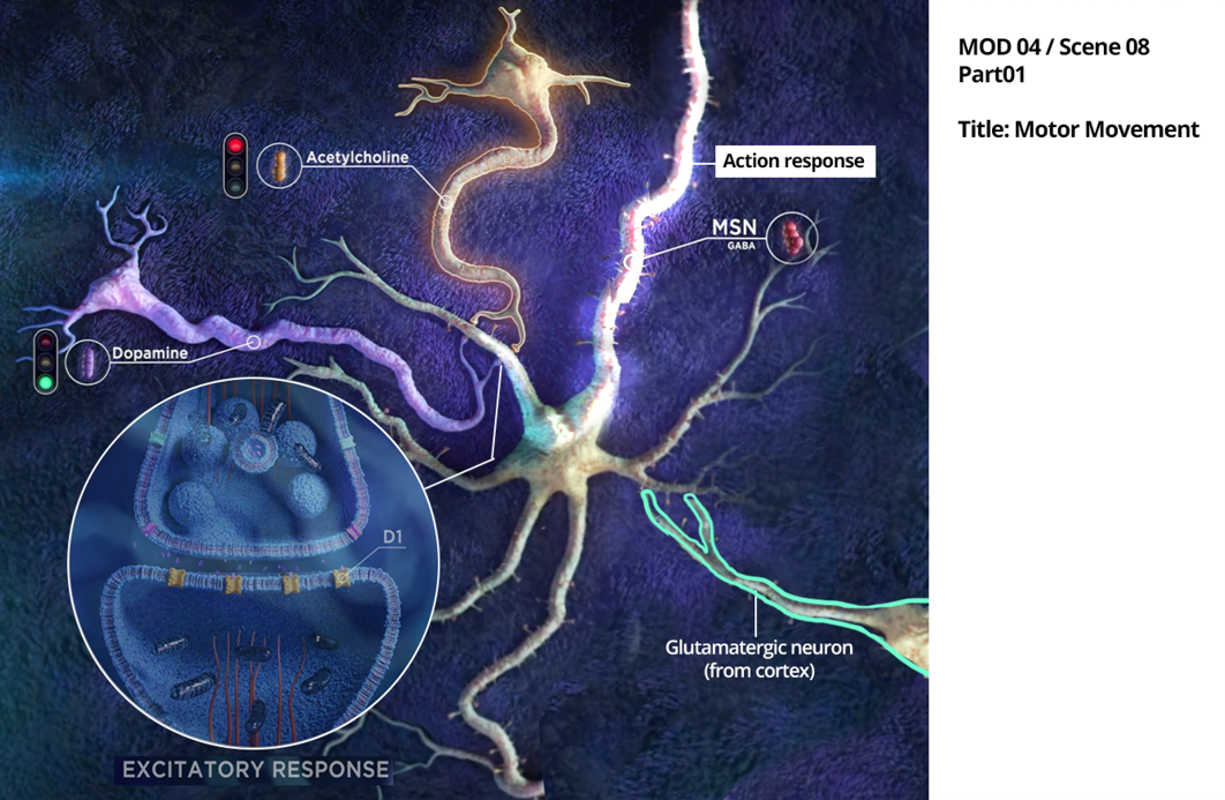
Intervoke set a color code that runs through every module. Green means excitatory glutamate signals, red means inhibitory GABA signals, purple means dopamine and orange means acetylcholine. Traffic lights on the thalamus show whether movement gets a "go" or a "stop," and an animated hand writing with a pen shows the movement result.
4. Review and revision
The storyboard went through several rounds of review with Teva. Reviewer notes refine labels, simplify terminology for clarity and keep colors and receptor designs consistent across modules. Changes are made at the storyboard stage, where they are fast and inexpensive.
5. 3D animation and interactive development
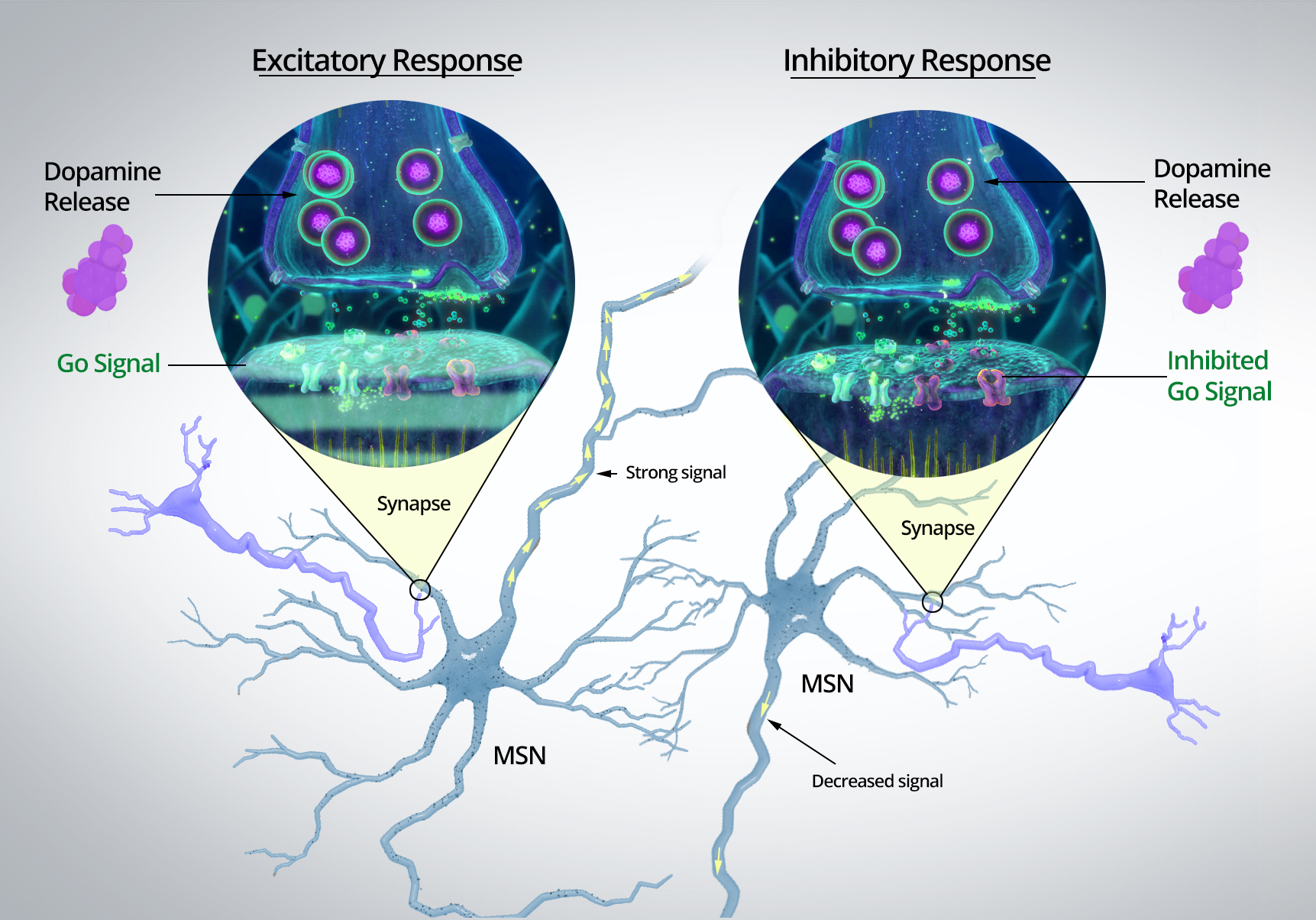
Intervoke built the 3D models, from the whole brain down to medium spiny neurons and their synapses, and produced both the narrated animations and the interactive scenes. The same models drive both modes, so what learners see in the animation matches what they explore.
6. Final rendering
The last stage turns storyboard frames into polished, high-resolution 3D medical illustration. The two frames below show the same concept, dopamine signaling at the synapse, as a storyboard sketch and as the final render.
Inside the app
Anatomy of Movement is an interactive 3D Windows desktop application that combines 3D animation, interactive 3D models and superimposed video.
- Narrated mode. Each scene plays as a voiceover-led 3D medical animation, so learners get the full story without needing to click anything.
- Interactive mode. The same scenes open as 3D models that learners can rotate, zoom and explore at their own pace.
- Labels that teach. Key terms pop up as labeled annotations at the moment the narrator says them. In interactive mode, labels stay on screen and open drop-down definitions.
- Gross anatomy to cellular level. The camera moves from a whole-brain cross-section into neurons and synapses and back, so learners always see how the pieces fit together.
- A modular curriculum. Each module builds on the one before. For example, Module 04, "Normal Movements," explains how the direct and indirect pathways, dopamine at D1 and D2 receptors, and acetylcholine work together to allow wanted movements and block unwanted ones. That understanding lays the groundwork for the modules on movement disorders and treatment.
The result
Teva now has a modular, interactive medical education application that takes HCPs from whole-brain anatomy down to receptor-level signaling. Because each module builds on the last, learners understand normal movement before they reach the disorders and treatments. The same 3D models and animations serve HCP training, field team education and patient conversations.
Kyle Householder of Teva summed up the collaboration: "Absolutely Incredible! That is the best way to describe my experience working with Intervoke."
Bring your science to life
Intervoke creates interactive 3D healthcare applications, medical education software, 3D medical animation, MoA and MoD animation and medical device animation for pharmaceutical, biotech and medical device companies. If your team needs to train HCPs or educate patients on a complex mechanism of action, book a discovery call to talk about your next project.
Sources
- Hyperkinetic Movement Disorders, Practical Neurology
- Movement Disorders, Teva Pharmaceuticals
- Interactive Medical Education, Intervoke
Let’s Get Started
Interested in learning more about how Intervoke can bring your science to life?
Contact us or book a Discovery Call to get started.


