
How We Created an Award Winning Mechanism of Action Animation for LYMPHIR
Creating an effective Mechanism of Action (MoA) animation requires a medical animation studio that understands the science as deeply as the production process. Molecular interactions, visual techniques, and creative direction must work together to explain a therapy clearly and guide the project from concept through Medical, Legal, and Regulatory review.
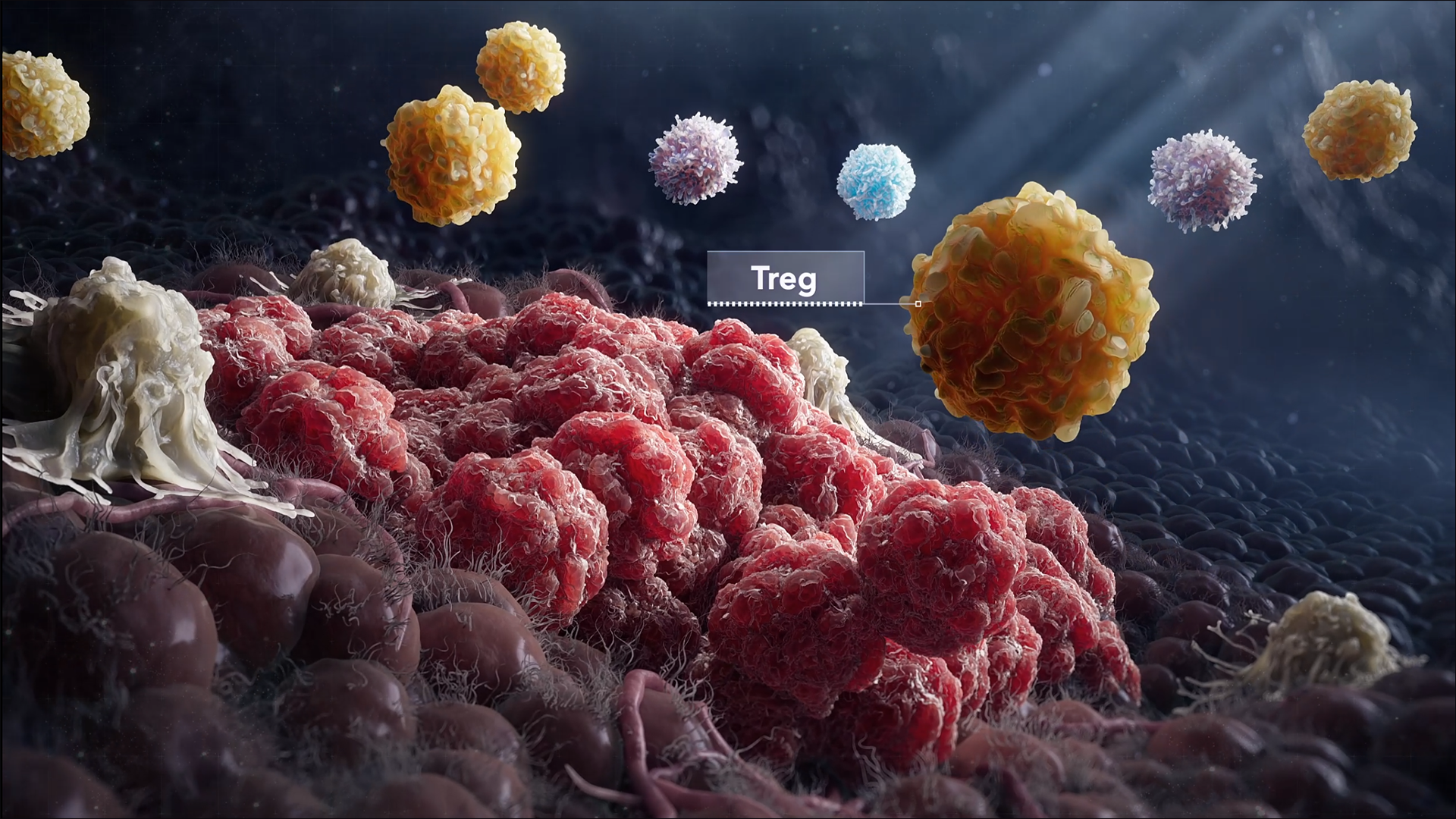
Creating an effective Mechanism of Action (MoA) animation requires a medical animation studio that understands the science as deeply as the production process. Molecular interactions, visual techniques, and creative direction must work together to explain a therapy clearly and guide the project from concept through Medical, Legal, and Regulatory review.
For LYMPHIR, Intervoke partnered with EVERSANA to translate a complex oncology mechanism into a cinematic, scientifically accurate MoA animation for pharmaceutical marketing and HCP education. The project shows why specialized expertise matters throughout production: it helps agency partners, scientific teams, artists, and reviewers work from a shared understanding of what each scene needs to communicate.
The finished animation received three TITAN Health Awards: two Platinum Awards and one Gold Award across Animation, Medical, and Technology and Science categories.
The Challenge of Making Complex Science Clear
LYMPHIR, or denileukin diftitox-cxdl, is an IL-2 receptor directed cytotoxin indicated for adults with relapsed or refractory Stage I–III cutaneous T-cell lymphoma (CTCL) after at least one prior systemic therapy. Its mechanism involves receptor targeting, internalization, and intracellular activity that ultimately results in cell death.¹
EVERSANA needed the animation to explain this mechanism in a scientifically accurate, visually engaging way for healthcare professionals treating CTCL. It was intended for HCP launch communications and congress use, including the ASH conference, with visuals that could also be repurposed for future promotional materials.
The challenge was to make that sequence easy to follow without oversimplifying the science. Each transition needed to show where the viewer was, what was happening, and how one biological event led to the next.
Partnering With EVERSANA
Intervoke worked closely with EVERSANA to establish the scientific and visual direction, beginning with the communication objectives, approved messaging, and the most important points the audience needed to understand. The teams developed the visual story together, determining how the mechanism should unfold and where complex concepts needed additional clarity.
“The EVERSANA team worked closely with us throughout the process, with regular reviews and open discussion around both the science and the visual storytelling. Ideas moved back and forth quickly, and their team was very collaborative about refining details while still giving us room to bring creative solutions to the table.
What made the partnership work so well was the combination of clear communication, fast feedback, and a shared focus on getting the science right without losing the visual impact.” Tyler Woods, Founder and Creative Director, Intervoke
Working with a studio that understands pharmaceutical animation gives those discussions a practical foundation. Scientific feedback can be translated into specific decisions about staging, camera direction, timing, and molecular behavior, helping each partner understand how a proposed change will affect the story and the production.
Building the Mechanism Through Storyboarding
Before full 3D production, Intervoke developed detailed storyboards that mapped the mechanism scene by scene. They established the scientific sequence, molecular interactions, camera direction, transitions, pacing, and visual emphasis.
For pharmaceutical animation, this stage gives the agency, scientific teams, creative team, and reviewers a shared visual framework before intensive production begins. It allows the team to assess whether the therapeutic target is clear, whether the sequence explains what follows receptor binding, and whether a visual could imply something beyond the approved scientific message.
“One of the more challenging parts of the storyboard was finding a clear way to visualize the intracellular steps of LYMPHIR’s mechanism, especially the toxin cleavage and movement across the membrane, without making the science feel overly complex. The storyboard evolved through several rounds with EVERSANA as we refined those details and simplified the sequence so the MOA remained both accurate and easy to follow.” Tyler Woods, Founder and Creative Director, Intervoke
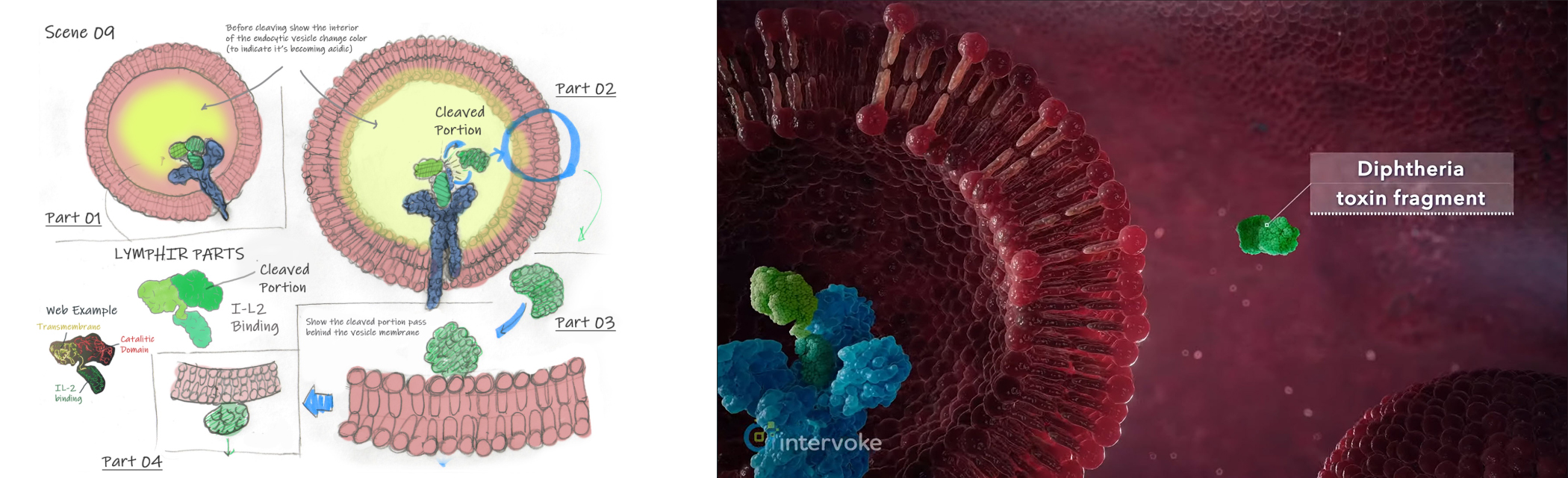
The Scene 09 storyboard makes that planning visible. Its annotations call for a color change inside the endocytic vesicle to indicate increasing acidity before cleavage, identify the molecular components, and map how the cleaved portion should be shown passing across the vesicle membrane. These notes connect the scientific sequence to concrete animation instructions.
Resolving these relationships during storyboarding helps streamline the work that follows. Partners can discuss the same visual sequence, and the production team can build from a clearer plan. Revisions remain part of the process, but scientific questions and creative decisions can be addressed before they become more involved changes to finished 3D scenes.
Bringing the Science Into 3D
Once the storyboard and scientific direction were established, Intervoke developed the cellular environments, molecular structures, therapeutic interactions, lighting, animation, camera movement, and visual effects needed to bring the LYMPHIR mechanism to life.
The animation takes viewers through biological environments that cannot be filmed directly, following the mechanism from receptor interaction at the cell surface into events inside the cell. Every visual decision serves that scientific story, using cinematic techniques to make the sequence easier to understand.
“A key production challenge was maintaining scientific clarity while moving across dramatically different scales, from the cell surface down into the intracellular mechanism. We used carefully controlled camera moves, molecular staging, lighting, and transitions to keep the viewer oriented while still giving the sequence the cinematic quality expected from a high-end MOA animation.” Tyler Woods, Founder and Creative Director, Intervoke
This is where technical skill and creative direction must work together. A camera move needs to preserve the viewer’s sense of location. Lighting needs to distinguish the structures involved. Molecular staging and pacing need to make the relevant interaction readable. Understanding these relationships helps the studio turn scientific requirements into a coherent visual experience and gives collaborators a clear basis for reviewing each scene.
Refining the Science Through MLR Review
The LYMPHIR animation moved through Medical, Legal, and Regulatory review, or MLR, where scientific representations, terminology, messaging, and visual interpretations were evaluated against approved materials.
Pharmaceutical animation is inherently iterative. A molecular interaction may need refinement, a visual may need clarification, or timing and emphasis may need to change so the animation communicates the science without implying more than the approved information supports. Intervoke incorporated these revisions while maintaining visual continuity, storytelling, and cinematic quality.
“During MLR review, feedback often focused on making sure the scientific action was not only accurate, but also unmistakable to the viewer. In one instance, a scene was refined to make the sequence of the molecular interaction and subsequent intracellular activity more visually explicit, improving both compliance clarity and overall comprehension.” Tyler Woods, Founder and Creative Director, Intervoke
A studio with experience in MoA production understands that these revisions affect more than an isolated frame. A change to one interaction can influence the timing, transitions, or explanation around it. Connecting reviewer feedback to the broader sequence helps the agency and production team refine the work consistently and keeps everyone focused on the same scientific objective.
The Result and Three TITAN Health Awards
The completed LYMPHIR Mechanism of Action animation brought together scientific communication, agency collaboration, detailed storyboarding, 3D medical animation, MLR review, and cinematic storytelling.
The project received two Platinum Awards in Animation and Medical, and one Gold Award in Technology and Science at the 2025 TITAN Health Awards. The winning entry was titled “Targeting CTCL with Precision - The Power of IL2 Receptor Therapy.”
The recognition reflects the project’s central creative goal: to make a sophisticated therapeutic mechanism understandable and memorable through scientifically grounded visual storytelling.

Why the Right MoA Studio Matters
The LYMPHIR project demonstrates the value of working with a studio that understands the intricate details, production techniques, and creative direction of Mechanism of Action animation. That expertise supports the partnership at every stage, from the initial scientific discussion to the final reviewed sequence.
When a studio can interpret the science, anticipate visual questions, and explain how creative choices affect understanding, collaborators have a clearer basis for making decisions. Storyboards become useful tools for alignment, production follows an established visual logic, and review feedback can be incorporated with a fuller understanding of its effect on the animation.
For pharmaceutical and biotechnology organizations and their agency partners, this approach can reduce avoidable back and forth and help streamline collaboration throughout production. The goal is a process in which scientific accuracy, creative quality, and clear communication support one another from the beginning.
Intervoke creates Mechanism of Action animation, Mechanism of Disease animation, pharmaceutical animation, medical device animation, interactive 3D experiences, and scientific visualization for life sciences organizations.
Have a complex therapy or scientific story to explain? Explore Intervoke’s medical animation capabilities or schedule a time to meet with our team to discuss your next project.
Let’s Get Started
Interested in learning more about how Intervoke can bring your science to life?
Contact us or book a Discovery Call to get started.


